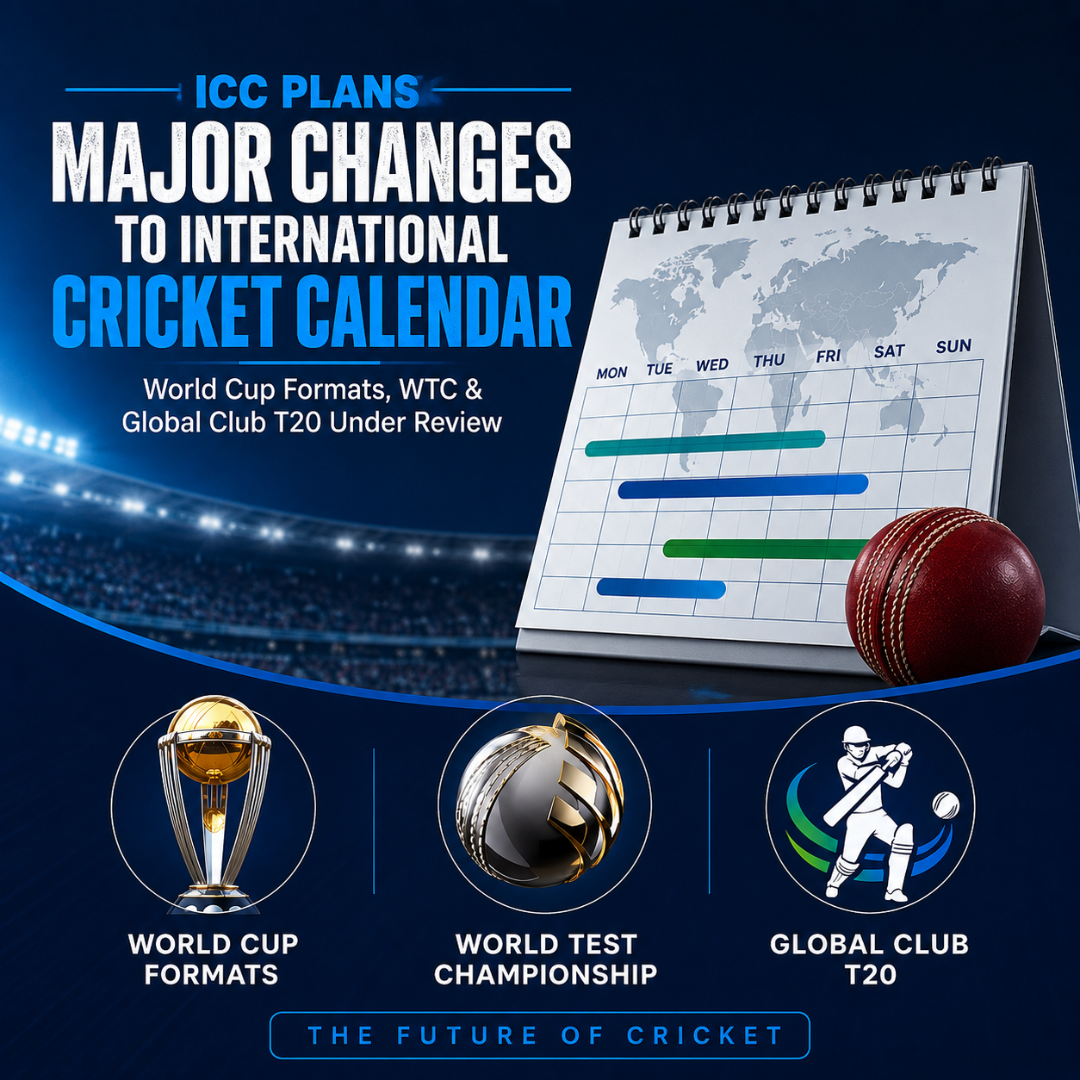
The International Cricket Council (ICC) is planning sweeping changes to the international cricket calendar. These reforms aim to improve competitive balance, increase commercial value, and support the global growth of the game. At its recent Annual General Meeting (AGM) in Edinburgh, the global governing body approved major format changes for upcoming World Cups. Additionally, administrators discussed radical proposals to restructure the World Test Championship (WTC) and establish a new global franchise tournament. These discussions mark a defining moment for the future of international cricket.
Why the ICC Is Reviewing the Calendar
The ICC is conducting a comprehensive strategic review of the global calendar, managed by the consulting firm McKinsey. The primary objective is to build a sustainable, long-term framework where Test matches, One Day Internationals (ODIs), and T20Is can thrive together.
With the rapid expansion of domestic franchise leagues, the international calendar faces unprecedented congestion. Furthermore, bilateral series not involving the “Big Three”—India, Australia, and England—frequently struggle for commercial viability. By restructuring global tournaments and proposing fixed windows, the ICC hopes to protect the relevance of bilateral cricket and maximize the sporting consequence of every fixture.
Major Changes Being Discussed
While some reforms have secured official approval, several radical proposals remain under review. The ICC will continue evaluating these ideas before making final decisions at its upcoming executive meetings in November.
Global Club T20 Championship
The ICC is exploring its potential role in running a World Club Championship for T20 franchises. This tournament would feature champion franchise teams from the world’s premier domestic leagues. If approved, this event would revive the concept of a global club championship, bridging the gap between franchise structures and international cricket.
World Test Championship Semi-Finals
The WTC currently concludes with a one-off final between the top two sides. The ICC is discussing the introduction of semi-finals. This change would keep more nations in mathematical contention deeper into each two-year cycle. Selectors and boards are also discussing expanding the WTC to 12 teams for the 2027–2029 edition. This expansion would bring Ireland, Zimbabwe, and Afghanistan into the tournament.
Evolution of the Future Tours Programme (FTP)
The current FTP is scheduled through 2031, meaning long-term changes will require patient transition. Proposals include implementing fixed, exclusive windows for each format. For example, ODIs might only take place in the 18 months leading up to a 50-over World Cup. Additionally, administrators are debating the creation of biennial continental championships and potentially reducing the length of ODI matches.
Changes Already Approved
While the strategic review continues, the ICC Board officially approved sweeping format overhauls for its marquee men’s events starting in 2027.
2027 ICC Men’s Cricket World Cup Format
The 2027 tournament, co-hosted by South Africa, Zimbabwe, and Namibia, will expand from 10 to 14 teams. The ICC has approved a revised three-stage format:
- Round 1: The three lowest-ranked qualified teams will play in a “Super Series” round-robin. The top team progresses.
- Round 2: The remaining 12 teams will split into two groups of six. The top three teams from each group, alongside the next best-placed team overall, will qualify for the next round.
- Round 3 (Super 7): The seven qualifying teams will play a 21-match round-robin. The top four teams progress to the semi-finals.
2028 ICC Men’s T20 World Cup Format
The 2028 tournament will maintain a 20-team structure but introduces a highly competitive Super 10 second stage.
- Group Stage: 20 teams will split into five groups of four. The top two teams from each group progress.
- Super 10 Stage: The 10 qualifying teams will split into two groups of five. The top team in each group secures an automatic spot in the semi-finals.
- Eliminators: The second and third-placed teams from each Super 10 group will play cross-over eliminator matches to secure the remaining semi-final slots.
How the New Calendar Could Impact International Cricket
These structural overhauls will significantly reshape international cricket. By adding multiple tournament stages, such as the Super 7 in 2027, the ICC ensures that every single match carries higher stakes. This approach reduces the number of “dead rubbers” and keeps fans highly engaged.
Furthermore, the new qualification pathways offer clearer goals for Associate Members. Countries like Scotland, Nepal, and the Netherlands will receive more structured opportunities to qualify for global events. However, integrating domestic franchise windows with international schedules will remain a delicate balancing act for administrators.
Reaction from the Cricket Community
The proposed reforms have triggered varied reactions across the sport. The World Cricketers’ Association (WCA) has strongly advocated for fixed international windows. The players’ union believes clear, dedicated windows are essential to managing player workload and helping athletes balance national duties with lucrative franchise contracts.
While major boards like Cricket Australia and the ECB support reforms that build tournament consequence, they remain protective of their bilateral schedules. Any move by the ICC to assert control over bilateral television revenues will likely face resistance from the world’s wealthiest boards.
Benefits and Challenges
+---------------------------------------------+---------------------------------------------+
|              Potential Benefits             |             Potential Challenges            |
+---------------------------------------------+---------------------------------------------+
| * More competitive global tournaments       | * High player workload and physical fatigue |
| * Better scheduling with fixed windows       | * A congested international cricket calendar|
| * Elevated commercial appeal for all boards | * Direct conflict with local T20 franchises |
| * Direct pathways for Associate nations     | * Devaluing historic bilateral Test series  |
+---------------------------------------------+---------------------------------------------+
Conclusion
The ICC’s proposed calendar reforms represent a bold attempt to modernize the sport. By revamping World Cup formats and discussing WTC semi-finals, the ICC is actively seeking to make every fixture meaningful. However, implementing these changes requires careful collaboration. The governing body must successfully balance player welfare, national pride, and the commercial realities of modern franchise leagues to secure the long-term future of the sport.
References & Credits
- International Cricket Council (ICC): Official Media Release: ICC Revamps Tournament Formats for Men’s Marquee Events (July 15, 2026).
- The Guardian: World Club T20 and Shorter ODIs Among ICC Options in Radical Overhaul of Calendar (July 5, 2026).
- Reuters Sports: ICC Explores Strategic Overhaul to Address Franchise Threat (July 15, 2026).
- ESPNcricinfo: ICC Annual Conference: World Test Championship Expansion and Calendar Proposals Analyzed (July 16, 2026).
- Sky Sports Cricket: Inside the AGM: How the New Super 7 Format Reshapes the 2027 World Cup (July 15, 2026).